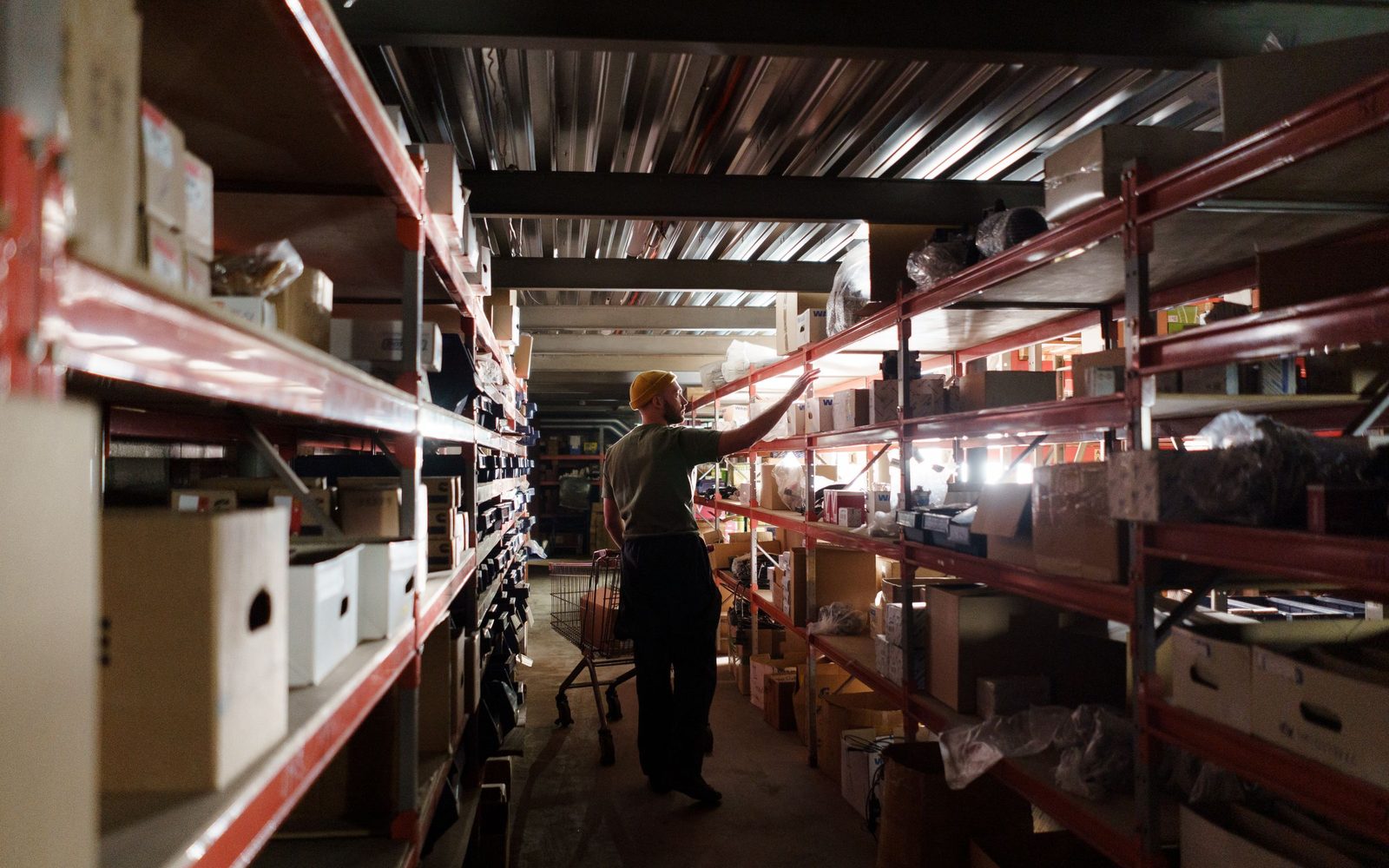
Your ERP says one thing, the field says another, and the gap costs you real money. Data reconciliation is the disciplined process of ingesting both sources, standardizing them, matching records, and flagging discrepancies deterministically so a human can validate the truth. It is a data problem you can solve, not a fatality you have to accept.
Every operations leader knows the feeling. The ERP shows 240 units of a part in a warehouse. Someone walks the aisle and counts 190. A pump the system marked as "in service" has been sitting broken in a yard for months. An asset flagged as lost turns up in another site under a different code. None of this is exotic. It is the daily texture of running a physical operation on top of digital records that drift apart.
The good news is that this drift is measurable, explainable, and fixable. It is also far more pervasive than most teams assume: in a landmark empirical study of nearly 370,000 retail inventory records across 37 stores, 65% did not match physical reality (Source: Management Science, DeHoratius & Raman, 2008). Let's break down why ERP and field data diverge, why it is expensive, and how a deterministic reconciliation process brings them back into alignment.
Why do ERP records and physical reality drift apart?
Your ERP is not lying to you on purpose. It reflects what people and systems told it, when they told it. The divergence comes from a handful of predictable causes:
- Manual entry. Counts, receipts, transfers and status changes typed by hand carry typos, wrong units, and skipped fields.
- Timing gaps. A movement happens in the field on Monday but gets recorded Thursday. Between those moments, the ERP is simply wrong.
- No live sync. Many field events, such as consumption, damage, relocation or scrapping, never make it back into the system at all.
- Lost, expired or duplicated assets. The same physical item exists under two codes, or an item recorded as available has expired, been cannibalized for parts, or quietly disappeared.
- Multiple sources of truth. ERP, TMS, spreadsheets and site-level tools each hold a slightly different version of the same object, and none of them agrees.
The pattern underneath all of these is the same: the digital record and the physical world update on different clocks, through different hands, with no shared referee.
Why does the gap cost real money?
An inaccurate record is not a cosmetic problem. It leaks cash in ways that are often hard to trace back to their cause:
- Rebuying assets you already own. When the system cannot confirm you have something, procurement buys it again. Owned inventory sits idle while budget goes out the door.
- Shortages and stockouts. Phantom stock that exists on screen but not on the shelf leads to missed commitments, expedited freight, and firefighting.
- Wrong reporting and planning. Forecasts, valuations and audits built on drifted data produce decisions that are confidently wrong.
- Wasted labor. Teams spend hours hunting for items, reconciling spreadsheets by hand, and re-counting because nobody trusts the last count.
The scale is easy to underestimate. IHL Group puts the global cost of inventory distortion, out-of-stocks and overstocks combined, at roughly $1['77'] trillion a year, with out-of-stocks alone accounting for about $1.2 trillion (Source: The Food Institute / IHL Group, 2024). The uncomfortable truth is that most organizations absorb these costs as background noise. They treat reconciliation as a periodic fire drill rather than a continuous discipline. That is where the money hides.
See how K.IOP reconciles ERP and field data with a full audit trail.
What does a reliable reconciliation process actually look like?
Reconciliation done well is not a heroic year-end count. It is a repeatable pipeline. At K.IOP, our Data Refinery, also called K-Refine, treats it as a deterministic sequence, meaning the same inputs always produce the same, explainable outputs, with no guessing and no hallucinations.
Here is the process, step by step:
1. Ingest both sources. Pull the system-of-record view from the ERP, TMS and any relevant files, and pull the physical view from field capture. You cannot reconcile what you have not connected.
2. Standardize. Normalize units, codes, date formats, naming conventions and reference tables so that "PMP-200" and "Pump 200" are recognized as the same thing. Most apparent discrepancies are really formatting mismatches in disguise.
3. Match and deduplicate. Link records across sources using deterministic keys and rules. Collapse duplicates so one physical asset maps to exactly one record, not three.
4. Flag discrepancies deterministically. Where the two views disagree in quantity, status, location or expiry, raise a clear, rule-based exception. Every flag carries the reason it was raised, so it is auditable rather than magical.
5. Human validation. The platform does not silently overwrite reality. It routes each discrepancy through a validation workflow where an operator confirms the true state, whether that means adjusting the record, scheduling a physical check, or writing off a lost asset.
6. Audit trail. Every match, merge, flag and correction is logged. When finance, an auditor or a regulator asks how a number was reached, you can show the full lineage instead of shrugging.
This is what "deterministic" buys you: not just clean data, but data you can defend.
How does physical-to-system capture close the loop?
Reconciliation is only as good as the field data feeding it. If the physical view is stale or manual, you are just comparing one guess against another.
This is where the DNA of our sister brand, K inventory, matters. Native RFID, IoT and mobile capture turn a physical walk-through into structured, timestamped data at the source. Instead of someone jotting counts on paper to be typed in later, a mobile scan or an RFID read records what is actually present, where, and when, and pushes it straight into the reconciliation pipeline.
That capability changes the economics of reconciliation:
- Counts become faster and far less error-prone.
- Status changes, such as an asset moving or going out of service, are recorded when they happen, not weeks later.
- The "physical truth" side of the comparison is finally trustworthy.
The impact is well documented. Across ten major retailers, including Adidas, Decathlon and Marks & Spencer, RFID-based cycle counting lifted stock accuracy from a typical 65-75% up to 93-99%, while sales rose by 1.5% to 5.5% and stock holdings fell by 2% to 13% (Source: ECR Retail Loss, 2020).
Connect, refine, operate. Capture connects the physical world, the refinery cleans and reconciles it, and the control room keeps operating on the result.
How do you keep ERP and field data aligned, continuously?
A one-time cleanup feels great for about a quarter. Then drift creeps back, because the causes never went away. The answer is to stop treating reconciliation as an event and start treating it as a running state.
That is the job of the Supply Chain Control Room. It sits as a unified layer over your ERP, TMS and files, and it keeps the reconciled picture live:
- KPIs show reconciliation health, such as how many records match, how many are flagged, and how old your last field capture is.
- Alerts fire when a discrepancy crosses a threshold or when a source goes stale, so you act on drift while it is small.
- Validation workflows turn each exception into a task with an owner, rather than an item on a spreadsheet nobody reads.
The shift is from periodic panic to continuous confidence. Instead of discovering at year-end that your books and your warehouse disagree, you see and resolve divergence as it appears.
Reconciliation, framed this way, stops being a fatality baked into physical operations. It becomes a governed, observable, and largely automated part of how you run.
FAQ
What is data reconciliation between ERP and field data?
It is the process of comparing what your ERP records say against what physically exists in the field, then identifying and resolving the differences. The goal is a single, trustworthy view of inventory and assets.
Why do ERP and field data drift apart in the first place?
Mainly manual entry errors, timing gaps between a physical event and its recording, missing synchronization, and duplicated or lost assets. Different systems also hold different versions of the same object with no shared referee.
Can reconciliation be automated safely?
Yes, when it is deterministic. Rules ingest, standardize, match and flag data the same way every time, then route real discrepancies to a human for validation rather than overwriting records silently. This keeps automation accurate and auditable.
How does RFID, IoT or mobile capture help?
They make the physical side of the comparison reliable by recording what is actually present, where and when, at the source. Trustworthy field data is what makes reconciliation meaningful instead of comparing two guesses.
How is this different from a periodic inventory count?
A periodic count is a snapshot that drifts almost immediately. A control room keeps reconciliation continuous, with live KPIs, alerts and validation workflows, so divergence is caught and fixed while it is still small.